Small business▲+2Since September 2026: 98% → 100%, +2 points. Inside the 11-point floor: within noise. Read over the models both editions asked.
100%from 98% in September 2026
Inside the floor by 9 pointsRank 1 of 36, unchanged
 Google · 2 categories · Ranked
| Category | Function | Share | Rank | Negative rate | Labels | Quadrant | Since September 2026 |
|---|---|---|---|---|---|---|---|
| Tag management | GTM data and infrastructure | 81% | 1 of 67 | 19% | 85 | endorsed leader | ▲+4Since September 2026: 77% → 80%, +4 points. Inside the 11-point floor: within noise. Read over the models both editions asked. |
| Web analytics | GTM data and infrastructure | 0% | 76 of 91 | 100% | 1 | under 10 labels · led by Google Analytics 4 at 57% |
| Category | September 2026 | Now | Change | Reading | Rank |
|---|---|---|---|---|---|
| Tag management | 77% | 80% | ▲+4Since September 2026: 77% → 80%, +4 points. Inside the 11-point floor: within noise. Read over the models both editions asked. | Within noise | Rank 1 of 67, unchanged |
| Web analytics | 0% | 0% | newNew since September 2026: not ranked then, 0% now. | New this edition | Rank 76 of 91, unchanged |
Shares here are read over the models both editions asked, so they can differ by a point or two from the standing above, which counts every model in this edition.
The floor is 11 points of share, measured: how far the models move a leader on their own when the same questions are asked twice with nothing changed. A larger change is movement; a smaller one is noise, and both are shown. Movement is read over the twelve models both editions asked; GPT-6 Luna, Muse Glimmer 30B joined this edition and are in the standing but not yet in the comparison. How the floor is measured · The editions
| Model | First choice | Alternative | Mention | Negative | Labels |
|---|---|---|---|---|---|
| Claude Haiku 4.5 | 4 | 1 | 0 | 1 | 6 |
| GPT-5.4 mini | 3 | 0 | 0 | 2 | 5 |
| Gemini 3.5 Flash | 5 | 0 | 0 | 1 | 6 |
| Perplexity Sonar | 4 | 1 | 0 | 0 | 5 |
| Grok 4.20 | 4 | 2 | 0 | 3 | 9 |
| Mistral Small | 4 | 0 | 1 | 1 | 6 |
| DeepSeek V4 Flash | 4 | 1 | 1 | 1 | 7 |
| Llama 4 Maverick | 2 | 0 | 3 | 1 | 6 |
| Qwen 3.7 Flash | 2 | 3 | 0 | 2 | 7 |
| Kimi K2 | 4 | 2 | 0 | 1 | 7 |
| GLM 4.7 FlashX | 4 | 0 | 0 | 1 | 5 |
| MiniMax M2.5 | 4 | 0 | 1 | 1 | 6 |
| GPT-6 Luna | 4 | 1 | 1 | 1 | 7 |
| Muse Glimmer 30B | 3 | 0 | 0 | 1 | 4 |
Verbatim evidence the judge attached to positive labels.
“Google Tag Manager is the most common general-purpose choice because it is free, simple to implement, and integrates well with Google products.” Perplexity Sonar · Tag management · comparative prompt · first choice
“The best tag management system for a company with a limited budget is Google Tag Manager. It is free and has a broad template ecosystem” Llama 4 Maverick · Tag management · budget prompt · first choice
“the most widely recommended solution for mid-market businesses due to its ease of use, robust features, and cost-effectiveness” Mistral Small · Tag management · direct prompt · first choice
“Google Tag Manager is the best free option for most teams, especially those already using Google Analytics or Google Ads.” Claude Haiku 4.5 · Tag management · scale prompt · first choice
Verbatim evidence attached to negative labels. A warning on a product with few labels is a warning; on a product with many, it is one voice among them.
“Avoid paid enterprise suites like GTM 360 unless you have a clear need for enterprise governance features” GPT-5.4 mini · Tag management · budget prompt · hard negative
“basic free tools like Google Tag Manager (GTM), which may suffice for smaller setups but often lacks robust permissions and support for larger teams” Grok 4.20 · Tag management · scale prompt · soft negative
“Free version lacks enterprise RBAC, SLAs (GTM AI Index: 32% negative).<br>- Unreliable preview/debugger; slowdowns; security via custom HTML” Grok 4.20 · Tag management · negative prompt · soft negative
“The free version lacks enterprise features such as advanced role-based access control (RBAC) and guaranteed service level agreements (SLAs)” Mistral Small · Tag management · negative prompt · soft negative
Citations exist only for the models that return a source list, five of the fourteen in this edition, so these counts come from 207 of the 228 answers that named Google Tag Manager and are not a share of its labels.
838 of the 838 domain citations in answers naming Google Tag Manager came from somebody else's page.
Pages are listed as the models cited them.
Search figures are US estimates from DataForSEO, read September 28, 2026; AI search demand is its modeled, directional estimate, not a count of queries to any assistant. The answers are this edition's. Two measurements side by side: neither is read as the cause of the other.
An email the morning each edition publishes: where this product moved, where it held, and by how much against the noise floor. One address, confirmed by a click; a stop link in every email.
Already following? Everything you follow, with a stop for each.
Fetched September 14, 2026, with a correction applied. These describe the company, not the product's standing, and a claimed page can dispute any of them. · Wikidata
Claiming is free and changes nothing in the data. A claimed page shows a verified contact who is told when each edition publishes and when Google Tag Manager's standing changes by more than the noise floor; the right to propose corrections to the vendor table, meaning names the judge wrote that should or should not read as Google Tag Manager, applied by version and listed in the change log; and a one-line description supplied by the vendor and marked as such.
A new claim receives the current edition's vendor brief for Google Tag Manager by email, built from the raw record of the edition. It shows:
AI models recommend Google Tag Manager first in Tag management this edition. Each badge says so in the buyer's words, names the edition, and links to the standing. The next edition issues a new badge; this one stays true as a record of October 2026.

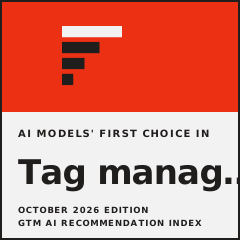

Badges read on light and dark pages. Alt text carries the claim, the category, the edition and the index, so it stays a citation where the image does not load.


